

WHAT IS A CUSTOMER DATA PLATFORM
If you work in a collegiate or professional sports organization, you may have heard the term "customer data platform" thrown around in vendor meetings, conference sessions, and the occasional LinkedIn post from someone trying to sell you software. The acronym CDP gets used loosely, often interchangeably with CRM, data warehouse, or customer engagement platform. That looseness is a problem, because when everything sounds like the same thing, nothing sounds like the thing you actually need.
So let's get specific.
A customer data platform is a system that pulls customer data from every source your organization uses, ticketing, donor management, merchandise, email marketing, streaming, app analytics, website behavior, and stitches it together into a single, unified profile for every person who interacts with your brand. That unified profile, sometimes called a golden record, becomes the source of truth that every other team and every other tool can draw from.
The CDP Institute, which maintains one of the more rigorous definitions of the category, describes a CDP as packaged software that creates a persistent, unified customer database accessible to other systems.¹ The key words there are packaged, persistent, and unified. Packaged means it is not a custom-built internal tool that breaks when the one engineer who built it leaves. Persistent means the data sticks around and evolves as new information comes in. Unified means the ticketing person, the development officer, and the marketing coordinator are all looking at the same picture of the same fan.
That last part is where sports organizations tend to fall short.
WHY THE CDP CATEGORY EXISTS
To understand why sports organizations need a CDP, it helps to understand why CDPs exist at all.
THE FRAGMENTATION PROBLEM
Over the past twenty years, the software ecosystem that supports customer-facing organizations has exploded. What used to be handled by one or two systems, maybe a CRM and an email tool, is now spread across fifteen, twenty, sometimes fifty different platforms. Each of those platforms collects data. Each of them has a different way of identifying customers. Each of them operates on its own schema, its own update cadence, and its own definition of what counts as a record.
The result is that the modern organization sits on top of a giant pile of customer data, and almost none of it talks to each other. A fan named Jennifer might exist as Jen in your ticketing system, Jennifer in your donor database, J. Martinez in your email platform, and an anonymous cookie ID in your website analytics. Those four records describe one person, but no system in your stack knows that.
According to the CDP Institute, organizations turn to CDPs for four primary reasons, the need for a unified customer view, the demand for real-time personalization, increasing pressure around data privacy and compliance, and the desire to reduce dependence on third-party cookies.² Every one of those pressures applies to sports organizations, often more acutely than to the consumer brands that first drove CDP adoption.
THE DIFFERENCE BETWEEN A CDP, A CRM, AND A DATA WAREHOUSE
This is where people get confused, so it is worth being precise.
A CRM, customer relationship management system, is designed to help individual users, typically sales or service reps, manage their interactions with specific customers. Salesforce defines a CRM as a tool for managing relationships and interactions with current and prospective customers, focused on the transactional and relational history between a rep and an account.³ It is a system of engagement. Think Salesforce, HubSpot, or the various ticketing CRMs that dominate collegiate athletics.
A data warehouse is a centralized store of raw data, typically used by analysts and data scientists to run queries, build dashboards, and generate reports. It is a system of record for analytical workloads. Think Snowflake, BigQuery, or Redshift. Sometimes warehouses are also provided as a service but usually powered by one of the aforementioned solutions.
A CDP sits between the two. As Salesforce puts it, a CDP collects and unifies first-party customer data from multiple sources to build a single, coherent, complete view of each customer.⁴ It takes raw data from every source, including your CRM and your warehouse, resolves identities across systems, and produces clean, unified customer profiles that can be pushed back out to any tool that needs them. It is a system of intelligence, built specifically around the customer.
A CRM tells you what a single rep did with a single account. A warehouse tells you what happened across your business last quarter. A CDP tells you who your customers actually are and what they are actually doing, in real time, across every channel.
WHY SPORTS ORGANIZATIONS SPECIFICALLY NEED A CDP
Sports organizations are, in some ways, the textbook case for why CDPs exist. In other ways, they are uniquely underserved by the existing software landscape.
THE SPORTS DATA STACK IS UNIQUELY FRAGMENTED
A typical Power 4 collegiate athletic department has fan and customer data spread across at least a dozen systems. Ticketing lives in Paciolan, Ticketmaster, or SeatGeek. Donor and development data lives in a separate fundraising CRM, often one that has not been meaningfully updated in a decade. Merchandise data lives with a licensing partner. Streaming and media data lives with a rights holder. Email marketing lives in one tool, SMS in another, app analytics in a third. Camp and clinic registrations live in a web form that exports to a spreadsheet.
Each of those systems was bought at a different time, by a different department, for a different purpose. None of them were designed to talk to each other. And in many cases, the contracts and APIs make it genuinely difficult to get data out of them in a usable form.
Compare this to a typical direct-to-consumer e-commerce company, which might have three or four systems total, all of them modern, all of them with clean APIs. Sports organizations are playing a much harder integration game with far fewer resources.
THE REVENUE UPSIDE IS ENORMOUS
The other reason sports organizations need a CDP is that the revenue opportunity buried in their data is enormous, and it is currently being left on the table.
The CDP Institute breaks down the business value of a CDP into a few concrete categories.⁵ First, suppression, the ability to stop marketing to people who have already converted, which immediately reduces wasted ad spend. Second, better targeting, which lowers cost per acquisition by pointing campaigns at the people most likely to respond. Third, personalization, which increases response rates and average order value. Fourth, retention, which keeps existing customers from churning. Each of these translates directly into the sports context.
Think about what a unified fan profile actually unlocks. If your development team can see that a mid-level donor has also bought single-game tickets for the past three seasons, attended two camps as a kid, and recently started streaming away games, that is a cultivation opportunity they would never spot in their siloed fundraising database. If your ticketing team can see that a season ticket holder has stopped opening emails and has not bought merchandise in eighteen months, that is a churn risk they can intervene on before renewal season. And if your marketing team can suppress donors from lapsed-buyer win-back campaigns, that is wasted spend recovered and a relationship protected.
McKinsey's research on personalization found that companies that grow faster drive forty percent more of their revenue from personalization than their slower-growing counterparts.⁶ The mechanism behind that gap is straightforward, faster-growing companies have invested in the data foundations that make personalization at scale possible. Sports organizations that want to grow revenue, whether from ticket sales, donor giving, or merchandise, need to make the same investment.
That opportunity is real, and the economics of collegiate athletics in particular are changing fast enough that data activation is moving from a nice-to-have to a survival requirement.
THE ACCESSIBILITY PROBLEM
Here is the part that gets overlooked in most CDP conversations. It is not enough to unify the data. The data also has to be usable by the people who need it.
In most athletic departments, the people who need to act on customer data are not data analysts. They are ticket sales reps, development officers, marketing coordinators, and assistant athletic directors. They do not write SQL. They do not want to open a ticket with IT every time they need a list of lapsed donors who live within a two-hour drive of a neutral site game.
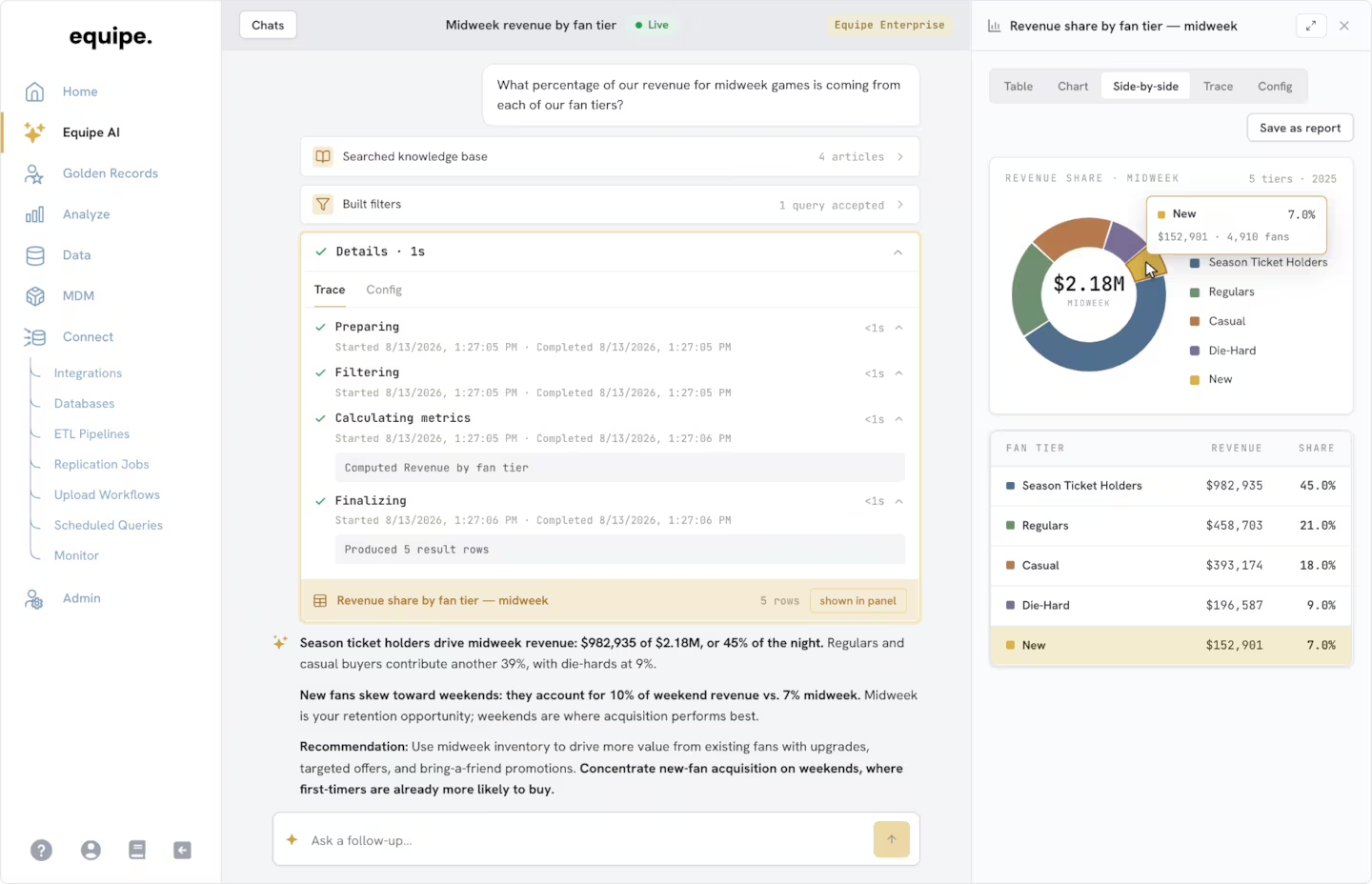
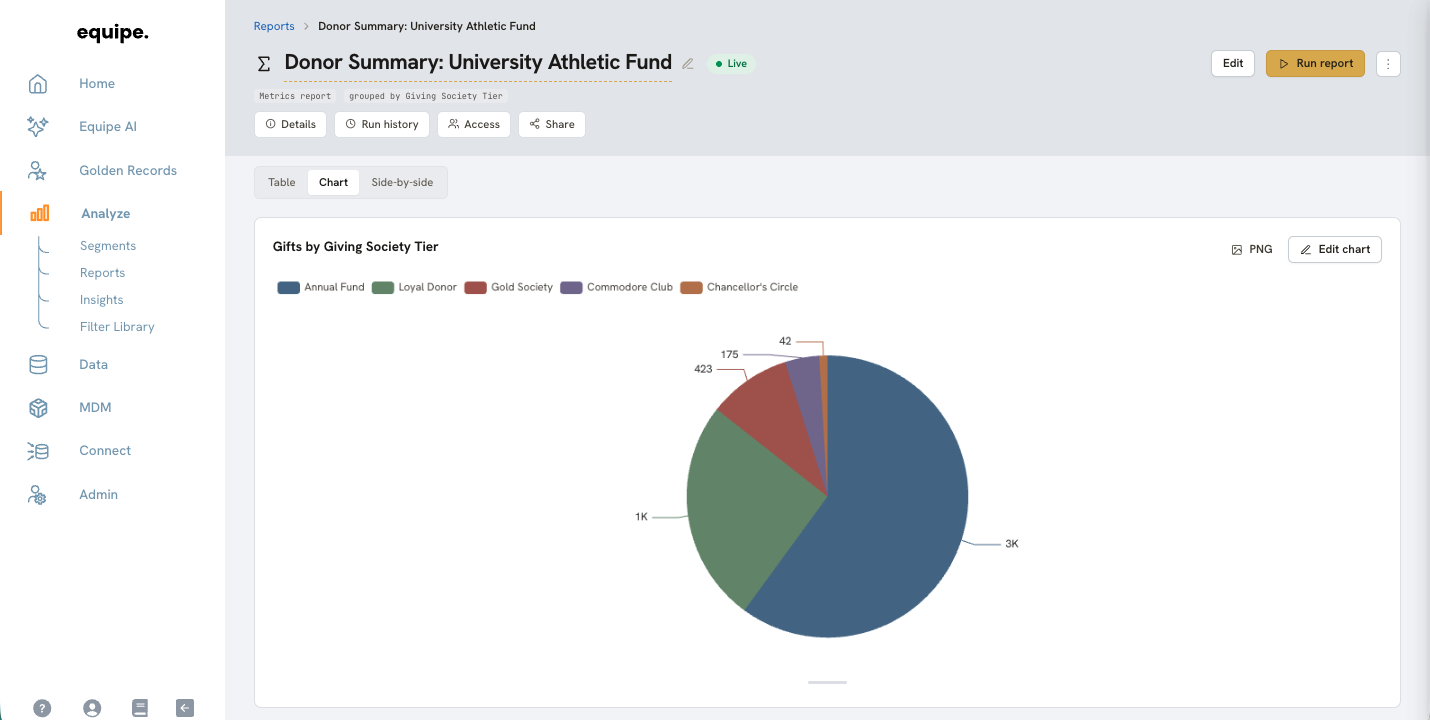
A good CDP closes that gap. It gives non-technical users the ability to query, segment, and activate customer data without having to involve the data team for every request. This is where a lot of first-generation CDPs fell short, and where the current generation of tools, Equipe included, is focused.
THE DATA FOUNDATION FOR AI
Every software company right now is talking about AI, and sports organizations are being pitched AI tools from every direction. Predictive churn models. Generative content tools. Copilots that sit on top of your existing systems and promise to surface insights automatically. Some of these tools are genuinely useful. Many of them are going to disappoint the people who buy them, and the reason is almost always the same.
AI runs on data. Specifically, it runs on clean, unified, well-structured data. If your customer records are scattered across twelve systems, duplicated, mislabeled, and missing key fields, the fanciest AI model in the world is going to produce garbage. This is the unglamorous truth behind most failed AI pilots, the model was fine, the data was not.
A CDP is the data foundation that makes AI actually work. When every fan is represented by a single, deduped, enriched profile that pulls from ticketing, giving, merchandise, digital, and engagement data, an AI model has something real to learn from. Churn prediction becomes possible because the model can see the full pattern of behavior across channels. Personalization becomes possible because the model knows who someone is, what they have bought, what they care about, and how they have engaged. Content generation becomes useful because the system can generate messages tailored to actual segments rather than generic audiences.
McKinsey defines personalization as the use of data to tailor messages and offers to specific customers, and notes that the gap between leaders and laggards in this discipline is widening as AI capabilities mature.⁷ The organizations that win are not the ones with the best AI. They are the ones with the best data foundation, which the best AI can then sit on top of.
For sports organizations, this matters for two reasons. First, the AI tools being sold to you are only going to be as good as the data you feed them, and right now most athletic departments cannot feed them anything clean. Second, building the data foundation first, before layering on AI, means that every future AI tool you adopt gets to start from a position of strength rather than having to reinvent identity resolution every time. You do the unification work once and every downstream tool, AI or otherwise, benefits.
Skipping this step and going straight to AI is the technology equivalent of hiring a world-class chef to cook in a kitchen with no ingredients. The chef cannot help you. The kitchen is the problem.
WHAT TO LOOK FOR IN A CDP FOR SPORTS
If you are evaluating a CDP for your organization, there are a few things worth pressing vendors on.
REAL INTEGRATION WITH SPORTS-SPECIFIC SYSTEMS
A generic CDP built for e-commerce will not plug into Paciolan out of the box. It may not plug into it at all without significant custom work. Ask vendors specifically which ticketing, fundraising, and media systems they have native or pre-built integrations for, and ask to see them running.
IDENTITY RESOLUTION THAT ACTUALLY WORKS
Unifying a Jen and a Jennifer and a J. Martinez into one record sounds simple. It is not. Ask vendors how they handle identity resolution, what their matching logic looks like, and what happens when the logic is wrong. A good CDP gives you visibility into how records are being merged and the ability to correct mistakes without breaking everything downstream.
ACTIVATION, NOT JUST STORAGE
A CDP that only stores unified data is a warehouse with extra steps. The value comes from activation, the ability to push segments and profiles back into the tools your teams actually use. Ask vendors how they handle syncing back to your CRM, your email platform, your ad networks, and your customer service tools.
USABILITY FOR NON-TECHNICAL USERS
This is the one most people skip in evaluations, and it is the one that will determine whether your CDP actually gets used. Ask to see the interface that a ticket rep or a development officer would use. If it looks like something built for a data engineer, your organization will not adopt it, no matter how good the underlying technology is.
THE BOTTOM LINE
A customer data platform is not a buzzword, a rebranded CRM, or a data warehouse with a friendlier name. It is a specific category of software that solves a specific problem, fragmented customer data spread across too many systems, and produces a specific output, unified, usable customer profiles that can be activated by every team and every tool in your organization, including the AI tools you are about to be asked to buy.
For sports organizations, that problem is more acute than almost any other industry, and the revenue opportunity tied to solving it is substantial. The departments that figure this out over the next few years are going to have a meaningful competitive advantage in ticket sales, fundraising, and fan engagement. The ones that do not are going to keep wondering why their renewal rates are slipping, their email open rates keep going down, and their expensive new AI tools are not producing the results the vendor promised.
The good news is that the tools to solve this have finally caught up to the problem. The better news is that you do not need a twenty-person data team to use them.
SOURCES
- CDP Institute, industry definition of a customer data platform as packaged software that creates a persistent, unified customer database accessible to other systems. Referenced via cdp.com.
- CDP Institute, "4 Reasons Companies Are Turning to CDPs." https://cdp.com/articles/4-reasons-companies-are-turning-to-cdps/
- Salesforce, "CDP vs CRM: What's the Difference?" https://www.salesforce.com/marketing/data/cdp-vs-crm/
- Salesforce, "CDP vs CRM: What's the Difference?" https://www.salesforce.com/marketing/data/cdp-vs-crm/
- CDP Institute, "The Business Value of a CDP," detailing suppression, targeting, personalization, and retention as core value drivers. https://cdp.com/articles/business-value-cdp/
- McKinsey & Company, "What is personalization?" McKinsey Explainers. Faster-growing companies drive 40% more of their revenue from personalization than slower-growing counterparts. https://www.mckinsey.com/featured-insights/mckinsey-explainers/what-is-personalization
- McKinsey & Company, "What is personalization?" McKinsey Explainers. https://www.mckinsey.com/featured-insights/mckinsey-explainers/what-is-personalization