

SMALL-CAPS, BIG OPPORTUNITY
This week, we're looking at the structural shift happening in women's sports, where Ariel Investments is projecting a $1B franchise within five years and the entire asset class is moving from passion play to platform business. The teams that capture the upside will be the ones with the data foundation to back it.
If you haven't seen already, we're heading to NACDA! We'll be doing free 30 minute data consulting coffee chats with anyone interested. Spots are filling up fast! Reach out if you're interested.
- Aaron
📈 THE SMALL-CAP SURGE
WHY WOMEN'S SPORTS NEED A DATA-FIRST FOUNDATION

Ariel Investments, an early backer of the Denver Summit and League One Volleyball, told Front Office Sports it expects a women's pro franchise to hit a $1 billion valuation within the next five years. That's not a stretch projection. The Connecticut Sun sold for a record $300 million in March, the New York Liberty hit a $450 million valuation last May, and the Denver Summit paid a $110 million expansion fee in early 2025.
The mental model from Ariel president Emma Rodriguez-Ayala is the most useful frame here. Women's sports, she said, are the "small-caps" of sports investing. Men's pro franchises are Nvidia and Microsoft, mature assets where doubling at scale is genuinely hard. Women's teams are the small-caps that can blow it out of the park.
From Passion Play to Platform Business
Last week at the USC Next Level Sports OC event, Alexander Stegmann Bhathal and Lisa Bhathal Merage of RAJ Sports, owners of the Sacramento Kings, Portland Thorns FC, and the incoming Portland Fire, framed the shift happening across sports as an asset class. The old model was a passion play. A local business owner buys the team, enjoys the seats, accepts the losses. The new model treats the team as a centerpiece with media rights, ticketing, sponsorship, and global reach orbiting around it as a platform business.
Their borrowed line stuck with us: "businesses have customers, sports have fans."
The job is converting fans into customers. And you cannot do that without data.
That conversion problem is amplified in women's sports. Media rights moments need to become identifiable, addressable data. Global fan bases are global customer bases that need infrastructure to support them. Even social signals, like the following on Portland Fire player Megan Gustafson's dog, Pancake, are real markers of affinity.
The question is whether an organization can track that follower into a fan, and that fan into a customer. This becomes the proof point in the small-cap growth story.
The Compounding Problem
Small-cap growth is exciting and also unforgiving. When you're a $300M franchise on the way to $1B, every fan, every donor, every season ticket holder, and every merch buyer matters disproportionately more than they do at a $10B legacy franchise. The teams that capture this growth won't be the ones with the deepest historical donor lists, they'll be the ones who can actually see, segment, and act on the customers they're acquiring right now.
Deloitte projects global women's sports revenue will reach $3 billion this year, a 340% increase in four years. That kind of growth doesn't compound by accident. It compounds when organizations can answer questions like:
- Which Summit fans who bought $200+ in merch also attended three or more home games?
- Who are the new Liberty season ticket holders trending toward a major gift?
- Which LOVB fans live within 50 miles of an upcoming match and haven't been to one yet?
These are not exotic questions. They are basic operational questions that get impossible to answer when ticketing, merchandise, donor, and engagement data live in separate systems.
A Texas-Sized Proof Point
We've seen what happens when an organization actually closes that gap. As recently covered in Sports Business Journal, Texas Athletics grew its women's basketball season ticket holders from 1,700 when the program moved to the Moody Center in 2022 to more than 6,000 today. That growth came in part from surfacing infrequent attendees and waitlist sitters from other sports, fans who already had affinity for Texas but were invisible in fragmented data. With unified records, the development team could finally see them and act.
Rob Novak, Texas CFO, said the win was getting information from the financial office to the ticketing and development teams in minutes instead of days. As Assistant AD Jack Luddy described it, the goal was building "almost that customer's Wikipedia page." What have they done in the past? What games have they attended? What can we do for them in the future?
That is the data foundation the asset class thesis depends on.
Building While You Grow
The legacy franchises in men's sports are unwinding decades of fragmented systems. Women's sports organizations have a window, a short one, to skip that step entirely.
The franchises building data foundations now are not just preparing for a $1B valuation. They are creating the conditions that make a $1B valuation possible.
💡PRODUCT HIGHLIGHT
CUSTOM FIELDS, CUSTOM ANSWERS
Every athletic department tracks data the rest of the industry doesn't. A booster classification your team has used for thirty years. A donor designation tied to a specific capital campaign. A loyalty status that only makes sense in your venue. Out-of-the-box CRM and ticketing systems force you to either jam these into a generic notes field or ignore them entirely, which means the questions only your organization knows how to ask are the ones your data can never answer.
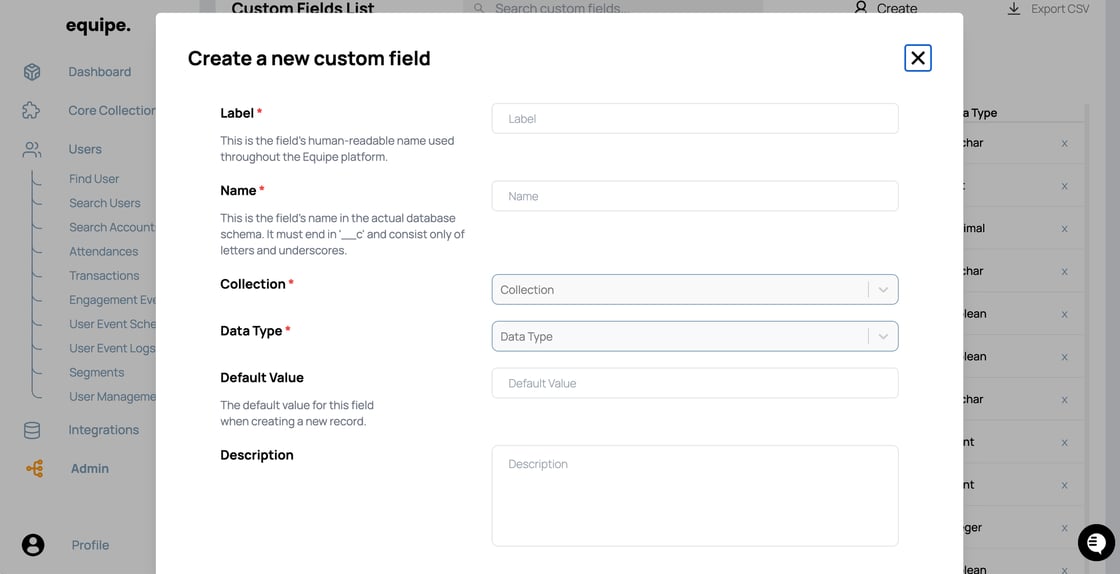
That's why we built Custom Fields in Equipe. On top of the identity and actions that form the core of every Golden Record, Custom Fields let your team define and track the attributes that matter to your organization, with the same structure and queryability as any standard field. They flow automatically into the API, integrations, and CRM syncs, and can even be used as identifiers in your MDM rules to drive how Golden Records are calculated.
With Custom Fields, you can:
- Extend Golden Records: Add organization-specific attributes like booster tiers, capital campaign designations, or legacy classifications directly onto every Golden Record.
- Calculate Across External Users: Define a custom flag once on External Users and let Equipe's MDM automatically calculate the right value on the Golden Record based on your datasource priority.
- Index What Matters: Choose which custom fields to index for fast filtering on the queries your team runs most, without paying the cost on the ones you don't.
🏢 FROM EQUIPE HQ
WE'RE GOING TO NACDA
Equipe is heading to NACDA, June 7–10 at Mandalay Bay Resort and Casino.
Nick Benson, Sajan Gutta, Aaron Glidden, and Cameron Korb will be on the ground in Las Vegas and would love to connect with anyone who's thinking about what better data infrastructure could mean for their program.
Space is filling up quick. Please reach out soon if you're interested in a free 30 minute data conversation over some coffee while at NACDA.
.jpeg)
🗞️ WHAT ELSE WE'RE READING
GOLDEN HORSES, BIG TEN BUCKS, AND SOCCER FROM SCRATCH
Speaking of Golden Records, trainer Cherie DeVaux became the first woman to win the Kentucky Derby as Golden Tempo edged Renegade at Churchill Downs. Meanwhile, the Big Ten posted a record $1.37B in distributions for FY25, and KKR is making a strategic investment in MLS Next Pro to build new clubs in underserved markets.
- Golden Tempo wins the Kentucky Derby as Cherie DeVaux becomes the first woman trainer to take the Run for the Roses
- Big Ten distributes a record $1.37B to its 18 members, $540M above its previous high.
- KKR partners with MLS Next Pro to build new clubs in 100+ underserved soccer markets