


SHARING IS CARING
Last week, baseball handed every revenue leader in sports a thought experiment. MLB's owners proposed pooling all 30 clubs' local TV money and splitting it evenly, a move built on the idea that sharing revenue more fairly lifts everyone. Maybe it does. But a bigger check and a better outcome are two different things, and the gap between them is the same one we keep seeing in college athletics.
Around Equipe we're getting ready to head to NACDA, and rounding up a few stories on the surprising ways programs are finding new revenue.
- Aaron
💰REV SHARE IS THE STARTING LINE
REV SHARE SETS THE BUDGET. DATA DECIDES THE RETURN.

MLB owners sent players their first salary cap proposal since 1994, and buried inside it was a change that matters far beyond baseball. According to The Athletic, the owners are proposing a $245.3 million cap, a $171.2 million floor, and a 50-50 split of revenues with players. The radical piece, though, is that all local media revenue across the 30 clubs would become central revenue, fully shared. Clubs with the richest TV contracts, the Yankees and Dodgers among them, are signaling a willingness to pool money they have always kept for themselves.
The argument from the league is about parity. As commissioner Rob Manfred has framed it, the sport is currently not a fair fight, and too many fans in too many markets have too little hope. Share the media money equally, the thinking goes, and the financial floor rises for everyone. A small-market club earning the same TV revenue as a big one has the resources to compete.
The cap-and-floor fight is the leagues' to have, and the players have their own strong view of it. The piece worth sitting with is the revenue-sharing mechanism itself, because it rests on an assumption that quietly travels well beyond baseball. The assumption is that distributing the money is the hard part, and that once a club has its share, the revenue outcome takes care of itself.
It does not. Pooling TV money guarantees a club a bigger check. It guarantees nothing about whether that club knows who its fans are, what they will pay for, or how to bring them back. The Athletic counts 12 clubs that would need to add a combined $617 million in payroll just to reach the proposed floor. Handing those clubs more shared revenue raises what they can spend. It does not tell them how to convert a dollar of media money into a renewed season ticket, a larger gift, or a sold-out building. That conversion is a separate capability, and no revenue formula contains it.
This is the same gap we have been pointing to in college athletics for months. When we wrote about Rutgers, the takeaway was that the Scarlet Knights don't just have an expense problem, they have a revenue problem. You cannot cut your way to prosperity in a Power 4 conference, and a bigger top line does not fix the problem on its own if the program cannot see where its revenue actually comes from. Now the parallel is direct. In the revenue-sharing era, college programs are receiving newly distributed money under their own evolving rules, and many are treating the arrival of that money as the finish line rather than the starting line.
The distinction is between a revenue share and a revenue engine. A revenue share is money that lands in the account. A revenue engine is the ability to turn it into more, and that runs entirely on data. Knowing which fans are likely to renew, which donors are ready for a larger ask, and which seats sit empty and why. None of that comes from a distribution formula. It comes from a unified, accurate view of every fan a program has, the kind that lets frontline staff act on a question in minutes instead of waiting on a quarterly export.
A club with that view will stretch the same shared dollar further than a rival operating in the dark, because it can find the high-propensity lead, fill the empty seat, and surface the next-best ask while there is still time to act. MLB's proposal, whatever becomes of the cap, is built on the belief that smarter revenue distribution lifts the whole league. It might. But distribution sets the starting line. What a club sees, and how fast it can act on what it sees, decides where it finishes. That is the contest every club should be preparing for now, and it is one no revenue split will settle.
💡PRODUCT HIGHLIGHT
THE REPORT YOU DON'T HAVE TO WAIT ON
In most athletic departments, a simple question can turn into a multi-day project. A revenue leader wants to know how primary purchase volume is trending year over year, or which segments are renewing and which are slipping, and the request goes into a queue. It waits on an analyst, or worse, on a vendor who will build it on their timeline and bill for the privilege. By the time the report comes back, the season has moved on and so has the window to act on it.
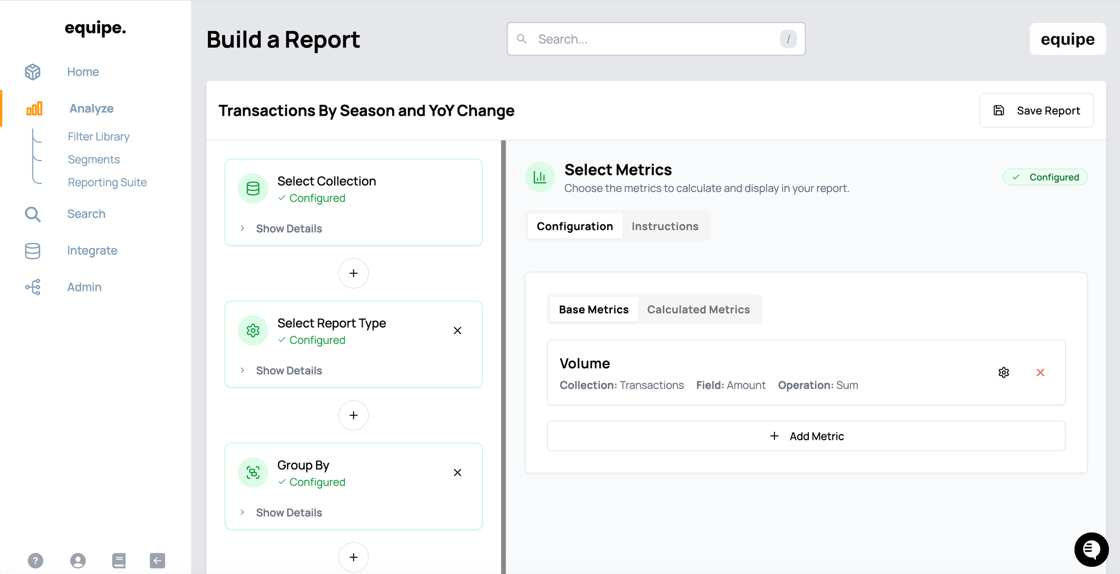
Equipe's Reporting Suite closes that gap. It is a guided, step-by-step builder that lets anyone on the revenue team define a data set, apply multi-step inclusion and exclusion filters, and either export the underlying records or calculate the metrics that matter, all without writing a query and without opening a ticket. You start by selecting a collection, narrow it with as many filter groups as the question requires, and then choose whether you want the raw records or a summarized view.
- Year-over-year purchase volume: Group primary purchases by season, sum the amount per year, and add calculated metrics for the raw change and the percent change, so you can see growth or decline at a glance.
- Grouped performance snapshots: Break renewal rates or transaction totals down by ticket type, location, or event, with the option to restrict to just the segments you care about.
- Targeted record exports: Chain filters to isolate exactly the records you need, customize the column headers, and archive the results to a downloadable CSV.
Reports are owned and permissioned by your team, run on demand inside the platform, and built by the people closest to the question.
When you need to know where your revenue is coming from, you shouldn't have to wait to find out. Now you don't have to with Equipe.
🏢 FROM EQUIPE HQ
WE'RE GOING TO NACDA
Equipe is heading to NACDA, June 7–10 at Mandalay Bay Resort and Casino.
Nick Benson, Sajan Gutta, Aaron Glidden, and Cameron Korb will be on the ground in Las Vegas and would love to connect with anyone who's thinking about what better data infrastructure could mean for their program.
Reach out soon if you're interested in a quick conversation over some coffee while at NACDA.
.jpeg)
🗞️ WHAT ELSE WE'RE READING
RANKINGS, MASKS, AND TUITION MATH
We take a gander at visualization of the financial gulf inside conferences, while two organizations prove that revenue creativity comes in unexpected forms. Trinity College is turning a country club sport into a seven-figure pipeline, and WWE is treating YouTube as the front door to its biggest storylines rather than a place to dump old clips.
- Conference Revenue/Spending, Ranked
- Squash Giant Trinity College Adds NCAA Fencing to Bolster Budget
- Why WWE Is Airing One of Its Most Anticipated Shows on YouTube
✉️ SUBSCRIBE
WANT THE TURNSTILE IN YOUR INBOX?
Sign up here. Delivered every Tuesday morning.